...trying to make science just a little more accessible.
I may not be an expert. I may not be a somebody. I may not even know very much at all, but what I do know is that most people do not understand SCIENCE.
...and so, what little I do know I am willing to share.
FOLLOW this BLOG!
FOLLOW this BLOG!
Want to learn more? Yeah, you do! Why wouldn't you? Well, it's simple. Just hit the 'FOLLOW' link below and to the left, and you can stay updated on all the new posts. Go on, don't be shy. Do it already!
"Gee. emM. Ooh!!" Most people have heard the acronym, and most people don't like it. This becomes obvious if you even mention it aloud, and notice the snarled faces of those who heard you. However, I have also noticed that many don't actually understand what a GMO is, what it isn't, and why these engineered organisms get so much press.
GMOs are Genetically Modified Organisms- that is, an organism that has it's genes modified. These types of organisms are very common and scientist use them in their research all the time; we use them to develop new drugs, make new antibodies, test protein functions, and much, much more. In the science laboratory, GMOs are incredibly useful and the research they are used for can help cure diseases and save lives. But I don't think most people are all that concerned about the GMOs in labs, rather I think most people care when these modification are made in crop plants that are grown for human consumption.
The most famous examples of GMO crops are:
Golden rice, which contains a gene to make Vitamin A.
Bt-Corn, a strain of corn that is resistant to a very common pest the corn borer.
But how are these crops made? How is rice modified to make vitamins and corn made to kill catepillars? Well, as you will recall from my earlier post about genes, genes are small pieces of DNA that are used by cells to make proteins. Based on this knowledge, scientists realized that if they put a new piece of DNA (i.e. a new gene) in a cell than that cell will make a new protein. It is really quite simple and elegant. In the case of Golden Rice, they first had to find out how Vitamin A is made naturally. They did this by looking at plants that are a natural source of Vitamin A, such as carrots. Carrots make a protein called 'beta-carotene'. This protein is what gives carrots their orange colour and their nutritional value. When we eat carrots we eat the beta-carotene which is then processed into Vitamin A in our livers (this is done by cutting the protein in half and creating two Vitamin A molecules). Once scientists learned how beta-carotene is made by carrots, all they had to do was insert the genes for beta-carotene synthesis into a seed of a rice, and tell the rice to turn the genes 'on' in the part of the plant we eat (this is important, because if the beta-carotene is not made in the part of the plant we eat (i.e. the rice, not the leaves) than we would not get the Vitamin A from this GMO). The genes (there are 2 of them) become part of the rice plant's genome, and this genetically modified plant can now make beta-carotene. Presto! This new rice plant is not only orange like carrots (hence the "Golden" name), but it is also nutritional like carrots. Scientifically speaking, "this is pretty damn cool, eh"!?
Now that we understand how GMOs can be made, lets consider why they get so much press. Well, the press centers around the huge and on-going debate about whether GMOs are the next best thing since sliced bread, or the worst application of science ever imagined. Those against GMOs are most often concerned about two major issues: potential risks to biodiversity and to human health. Risks to biodiversity include concerns about the unnatural exchange of genetic information and the shuffling of genes from one organism into another. Many people are worried that the pollen from a GMO plant will spread into wild species and change crop plants forever. Another major concern for biodiversity is that we will harm animals and insects that eat or come into contact with the GMO crops. For instance, are butterflies that pollinate corn plants being harmed by the genes in Bt-Corn? What about the humans that eat this corn? Will they be harmed from the genes? Many of the crops have not been properly tested for long-term impacts on health. These are all very relevant concerns that do not have clear answers yet.
This movie gives a very nice description of how genes are actually inserted into the cells of GMOs. It also discusses the public concern around these crops and highlights the need for increased research around the potential side-effects of mass producing GMOs. The video showcases the con-side of the debate.
On the other side of the debate, are the pro-GMO. These people would say creating GMOs is similar to a natural processes that occurs during evolution. If the genes of plants become modified anyways over time, what is so wrong with humans speeding it up? They also say that creating GMOs is not new, and that humans have practiced this technique since the advent of agriculture by selecting plants that make larger tomotoes or more cobs of corn. This type of selection has genetically changed most of the foods we eat and is why wild plants look and taste very different from the food we buy in our grocery stores. These same proponents will state the potential environmental and nutritional benefits of GMOs. For instance, by putting herbicide and pesticide genes into plants we no longer need to spray copious amounts of chemicals all over the crop. And the nutritional benefits of GMOs can also help reduce malnutrition in the poorest of nations.
Lets return to the Golden Rice story and address the question: "why even bother make rice golden?" If we can get Vitamin A from carrots why would we even put it into rice? Well, this is because rice is actually the number one food source for most of the world's population. Virtually everyone eats rice, and for the poorest people, rice may be all they eat. It is relatively cheap, it stores well and it is high in calories- so a little goes a long way. This explains why the creators of Golden Rice decided to use rice. They decided to put beta-carotene in it in order to help eradicate Vitamin A deficiencies. It turns out that while we Canadians enjoy carrots with virtually every meal, over 250 million children in other nations are suffering from a lack of carrots! Vitamin A deficiencies are very common in the poorest countries of the world, and Golden Rice can potentially help relieve this problem.
Based on the potential benefits of GMOs, it is my opinion that in theory GMOs have great promise and can actually be very helpful to humans and the environment. We can increase the nutritional value of food and reduce the use of dangerous chemicals. However, in practice these crops are made by companies. These companies include the massive multinational corporation Monsanto. And, like all companies, GMO companies have one priority: to make money. So there are strict patents that are placed on these crops that make the seeds very expensive to buy. And worse, most GMOs are made to make the companies more money; they insert genes to extend the shelf-life of the plant instead of the nutritional value. This results in most GMOs not actually being helpful to humans at all! And so, although in theory GMOs can be great, in practice and in policy that greatness is not being realized.
Here is a very interesting note written by UBC graduate student Ana Chávez Steenbock. She discusses the potential dangers of GMOs and the political issues surrounding this controversial technology.
A team lead by Ph.D. Ignacio Chapela found genetically modified corn (maize) growing in the states of Oaxaca, Mexico. Environmentalists claim that the arrival of trangenic strains there could disrupt the genome of naturally bred corn. However, his scientific paper published in 2001 was discredited since such news was not benefiting the biotech industry. It was the first paper ever retracted by the prestigious journal Nature. [Nature 414, 541-543 (29 November 2001) doi:10.1038/35107068]
What a shame that scientist doing honest research that conflicts with the interest of the biotech industry have to fight to show their results are valid. This publication got the UC Berkeley professor Chapela to have his tenure denied due to pressure from the biotech company Monsanto on the University.
Chapela filed a lawsuit against the Regents of the University of California, saying that there were corporate conflicts of interest in the tenure decision process. In April 2005 UC Berkeley Chancellor Robert Birgeneau granted tenure.
Chapela has emerged as perhaps the leading academic critic of genetically modified organisms (GMOs), and a champion of opponents of the increasing corporate control over the world’s food supply."
"Difficult to Do Science Not Promotional of the Biotech Industry"
When we talk about science we can theorize topics as vast as our solar system and characterize molecules smaller than atoms, but it can be hard to appreciate the difference between these extremes.
Well this Scale of the Universe can really help give some perspective on the AWESOME world we find ourselves in, and help us understand where we fit in it.
The scale really gave me some perspective! I marveled at how an AM radio wavelength is almost as large as the Eiffel Tower and that a red blood cell (which plays such a large role in our survival) is smaller than a mere droplet of fog. And then, when I realized that these items are nothing compared to the smallness of Einstein's quantum foam or the vastness of our Galaxy, I better appreciated my place in this world, which is pretty trivial.
Next time I get panicked because I missed my bus and will be late for work, or frustrated that my boyfriend broke my favorite mug, I think I will take a moment to gain some more perspective...
That's right, you have a genome. And your genome is your friend. But what is a genome? And what is it doing for you?
Your genome is what makes you you. It is all the information required to build you... well, more accurately, it is all the information in your body that is required to build you (the external environment and your life experiences also play a very important part in designing you, but we will not be discussing that today). Essentially, your genome is your DNA (short for 'deoxyribonucleic acid' ...try saying that 3x fast!) and your DNA is your genetic blueprint. Lets start there.
DNA - it is in us all (in the form of 'chromosomes') and it is what makes each of us an individual. DNA is a very long string of letters, called nucleic acids. These letters spell words, that are called genes. Basically DNA is a more advanced binary code used by cells. There are four letters in the alphabet of DNA: adenine, cytosine, thymine and guanine (shortened to A, C, T and G). These letters are specific chemicals that are strung together billions of times to make a very long DNA molecule, which folds to form the classical 'double helix' structure that most of us have heard about. These four letters are used to spell all the genes in our body, and this string of DNA is what we call our 'genome'.
Essentially, our genome is a specific DNA molecule that is found in every single cell of our entire body, and that contains all the directions needed to build us. The specific genes that are on this string will make specific types of proteins, these specific proteins will make us a specific type of person. This phenomenon was discussed in the earlier post "Good Genes, what are they and how can I get some?" However our genome is a little more complicated than that. Although each cell contains the same DNA there are many levels of regulation occurring in our cells that control which genes are used and when these genes are used. This regulation is very important because how each cell uses the DNA will determine how that cell behaves.
Gene Regulation is very complex. It relies on specific regions and chemical modifications that are on DNA and that are used to tell a cell which genes to use. By controlling the genes a cell uses we control how that cell behaves, which is necessary in order to build the different tissues that make up our body
As I mentioned the same string of DNA is in every single cell of our body, but as we know the cells in our body are specialized for certain functions: we have skin cells, liver cells, blood cells brain cells, etc. So, how does the same script (DNA) direct so many different types of cells? Each cell type is specialized because of the genes it uses. A liver cell only uses liver genes, and only makes liver proteins. A brain cell only uses brain cell genes to make brain cell proteins. This is how a cell becomes specialized.
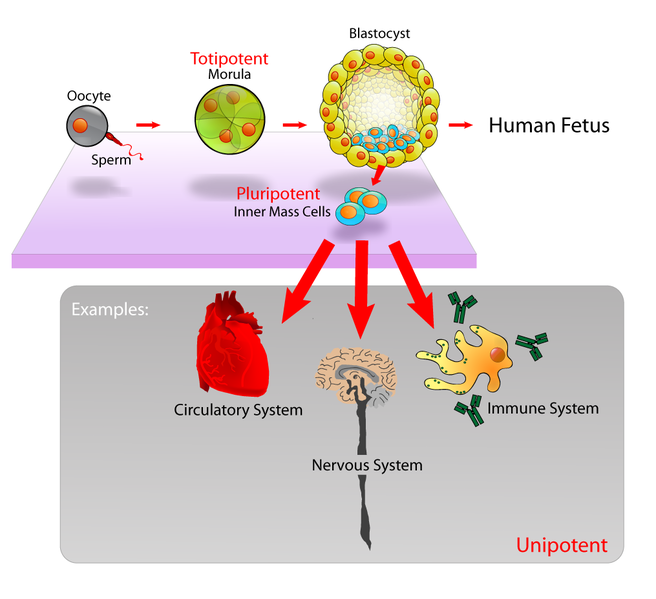
But how does a cell determine which genes to use?This is where gene regulation really comes into play. There are specific regions of DNA (called 'promoters' and 'repressors'), and specific chemical modifications (called 'epigenetic' changes) that are on DNA and that are used to tell each cell which genes to use, and which genes not to use. Some regions on DNA will 'turn off' specific genes, and some chemical modifications will 'turn on' other genes. It is the combination of 'on' and 'off' signals that determine the proteins a cell makes, and the way the cell behaves. This is how a liver cell 'turns off' the genes needed for a heart cell, which 'turns off' the genes needed for a skin cell, which itself 'turns on' the genes needed to build skin. Through these complex levels of gene regulation each cell 'terminally differentiates', a concept we learned about in the stem cells post. This is how a single string of DNA, our genome, directs all the cells in our body in order to make us a whole and complete individual.
A final interesting fact about genomes is that every organism has one. A bacteria, a fly, a mouse, a fish, a plant and an elephant all have a genome. And these genomes are all made up from the exact same four letters that make us up! What makes a mouse different from a fly is the set of genes that are encoded in their genome. Each animal and plant has a specific and unique set of letters in their string of DNA. In a fly's genome there will be genes to make wings and genes that allow it to lay eggs. In a mouse there will be genes that make fur and genes that build four legs. In a plant there will be genes to grow roots and genes to make seeds. If a scientist were to stumble upon a random string of DNA they would be able to determine the owner of that genome simply by looking at the genes encoded in it! This is how a criminal can be caught by leaving behind cells at the scene of a crime. DNA is that specific. It is amazing how every species on this planet are built using the same four letters! The diversity we see all around us is simply based on differences in how those four letters a strung together and used!
What exactly does it mean to have 'good' genes... or 'bad' genes for that matter? And why do people say 'it's all in the genes!' when someone beats cancer or wins a marathon? In fact, what the heck is a gene?
Since Gregor Mendel (1822-1884) started playing in his garden with pea plants, the concept of the gene was born. It all began when Mendel recognized that the colour of a plant's flower was directly linked to the colour of its parents- a simple observation that changed how we understand all living things. Today we take it for granted that we will look like our parents. We accept that we inherit our parents' attributes. Well, this is because we inherit their genes- both the 'good' and the 'bad'.
Actually, what we inherit from our parents is their DNA, and it is the DNA that contains the genes. You can learn more about DNA in the upcoming post "you and your genome". Essentially, DNA is a very long string of letters (nucleic acids) that make up words (genes). It is in every single cell of our body, and it is how each cell uses the DNA that determines how the cell behaves.
And what does that mean - how a cell uses DNA? Well, DNA is like a script, it is like a book that is filled with information. In order to use DNA the cell must decode the script, it must read the book. A cell reads DNA just like we do: by reading one word, and then another word, and another, until we have all the information we need. Genes are the words in the book of DNA; genes are the bits of information.
The information encoded by a gene is translated into a protein, and each gene makes a different protein. There are thousands of different proteins that make up our cells- proteins are the building blocks of our bodies. If a cell is like a city than proteins are the workers in the city. In every city we have bankers, builders, policemen, politicians, protestors (if there is a G20 summit in town), factory workers, etc.... each of these people have their own job and function in the city. Similarly, each protein in the cell plays a different role and each protein does its job to ensure the cell runs properly. Proteins are encoded by genes. When the cell reads DNA and uses a gene (called 'gene expression') it does so by making a protein, and it is the protein that will do the work. This is the primary function of a gene.
These are just a few of the proteins that genes encode for.
Each of these proteins has a very specific and unique
sequence of amino acids that results in a specific and
unique shape and function.
Now that we have covered the basic concept of a gene, lets consider how a gene can help or hurt us. Although generally every cell in our body contains the same DNA, sometimes there are minor changes (called genetic mutations) in the DNA that can drastically affect the gene, and thus affect how the cell behaves. This is because very slight difference in genes can result in huge differences in proteins, which can in turn change how the protein does it's job. If the activity of a protein changes than the behaviour of the cell can change, and this can result in changes in how we behave.
Lets return to our 'book of words' analogy. We all know what words are, we use them every single day. A word is a sound used to describe something specific. Each word is different because it sounds different and this allows us to name or describe different things. The slightest difference in a word can result in a huge change in its meaning (take 'pot' and 'lot', for instance). Well, genes are the exact same way. Each gene has a unique and specific 'sound' which results in a unique and specific 'meaning'. The 'sound' of the gene is based on the DNA, and the 'meaning' of the gene is based on the protein it encodes.
Just like the letters in a word will determine its meaning, the letters in a gene will determine the type of protein it makes. This is because proteins are made from 'amino acids' (which are 20 chemicals that our body gets, or makes, when we metabolize our food) and the letters that make up a gene encode for a very specific set of amino acids, that make a very specific protein. So if there is a change in the letters of a gene there will be a change in the amino acids of the protein, which results in a change in the function of the protein. If the change is bad (a 'deleterious mutation') than it may result in the protein not being able to do its job anymore, and this can cause a huge problem for the cell (just think about the disruption a strike can cause in a city). On the other hand, if a change is good (called a 'beneficial mutation') than it can improve how the protein does it's job, which may give us some kind of advantage. These slight differences in our genes is what makes some genes 'good' and others 'bad'. For instance, if we have a mutation in a gene that results in a protein using energy more efficiently than we may be able to run faster and win a marathon. It is the sum of all these differences that make all of us individuals and that make each of us who we are.
In short, the DNA we inherit from our parents encodes for genes that in turn make proteins. Sometimes there are very slight differences in our genes which result in differences in the proteins our cells make. These slight differences in proteins lead to differences in us. Some of these differences are good (like a gene variation that makes someone run faster) and some of these differences are bad (such as a gene variation that makes it likely we will get cancer). However, whether a mutation or gene variation is beneficial or deleterious really depends on the situation. In some contexts it may be good to have a protein that burns energy faster, because you can use that energy to run faster; but in other contexts it can be bad because you will need to eat more food to maintain your energy levels, and there may not be more food to eat. Therefore, in order to get a 'good' gene you have to be in the right place at the time and with the right mutation. Good or bad is simply context-dependent! I think this brings a whole new meaning to the age-old expression, 'timing is everything!'
Stem cells! Stem cells!! Stem cells!!! It seems every time I open a newspaper or turn on the tv there is some new breakthrough regarding stem cells. But what exactly are these cells? And why does everyone get so excited about them?
In order to understand what a stem cell is we have to first consider what it isn't. Essentially, a stem cell is not a 'somatic' cell, meaning it is not a heart cell, muscle cell, liver cell, lung cell, brain cell or any other 'common' cell. These 'common' types of cells are fully mature and will not become any other kind of cell. They are 'terminally differentiated' -'differentiated' because they have developed from an immature cell and have mature cell characteristics; 'terminally' because they are at the terminus, or end, of their differentiation pathway and will not change into any other cell type. One might say that, "once a somatic cell, always a somatic cell". In short, somatic cells are the mature cells that make up the different tissues (heart, lung, stomach, brain etc) in an adult body. Although stem cells are also present in the adult body, stem cells are not somatic cells.
So now that we know what a stem cell isn't (i.e. a 'terminally differentiated' mature cell), what kind of cell is it? Well, a stem cell is an 'immature' cell that has the ability to generate different types of somatic cells. Generally speaking, a stem cell has the potential to make all the cells of a given tissue. For example, there are blood stem cells (called hematopoietic stem cells) that can generate all the cells in our blood, including red blood cells and white immune cells. Another type of stem cell exists in the brain, called a neural stem cell, and this stem cell is able to generate different brain cells, such as neurons astrocytes and oligodendrocytes. These stem cells are known as 'adult stem cells' and are to be distinguished from embryonic stem cells (which will have to be a topic for a later post). Suffice it to say that embryonic stem cells can generate ALL the cells in the whole body (because they are "pluripotent"), while adult stem cells are more restricted and can generate only the cell types within a specific tissue.
A cell's ability to generate different types of 'common' somatic cells (known as 'multipotency') is not the only defining feature of a stem cell. A stem cell is also able to self-renew. This means that when a stem cell divides it can create another stem cell. This is very important. What this means is that when a stem cell generates another cell type (say when it is repairing injured tissue) it will also generate another stem cell. As such, even while new 'common' cells are being made, the population of stem cells is continually replenished, ensuring stem cells are present for the entire life span of the organism.
So what is the big deal? Why do we need stem cells and why do we need them for our entire life? Well, the body keeps these cells in an immature state just in case there is some kind of damage or injury to one of our organs or tissues. Since stem cells can generate the different cell types in a given tissue the body is able to repair itself. Stem cells are like Superheros that are called into action when evil strikes the body. Also, another important (albeit less heroic) aspect of stem cells is that they ensure old, malfunctioning cells are replaced by new and fresh ones. This maintains the health of our tissues over time and ensures that our liver keeps working as a liver.
I am sure right now you are asking yourself, "than why the heck don't we live forever?". And I say, "good question!". This is because stem cells themselves will age. Although scientists have different ideas on this topic, many believe that stem cells have a lifespan and that they are only able to divide a specific number of times. Maybe you have heard that every heart beats roughly the same number of times and that an elephant and a mouse will have the same number of heart beats in a lifespan; the mouse's heart beats faster and thus uses up these beats much faster than an elephant. Since the elephant uses up its alloted heart beats slower it lives longer. Well, I believe this is analogous to stem cells. A cell can divide x number of times and how fast they divide (and thus how fast they get to the number x) will determine how long they are around. Thus, as we age our stem cells age and they loose their ability to repair our tissues and organs. Consequently, our body ages. Also, it should be mentioned that some kinds of injuries cannot be fixed. This is because not all organs have stem cells, or because something else interferes with the ability of the stem cells to assume their Superhero role and repair the tissue.
Finally, this brings me to the 'why do i care' bit. Well everyone is so excited by stem cells because scientists believe that they can be used to re-grow injured organs, or can be used to repair diseased tissues. For instance, skin stem cells can be used to grow new skin for burn victims. Or blood stem cells can be manipulated or transplanted in order to generate healthy blood cells for leukemia patients. Basically, if we are able to understand how the body controls stem cells than maybe we can control them too. And if we can control stem cells than we can use them to repair our bodies. Heck, maybe one day we really will live forever...